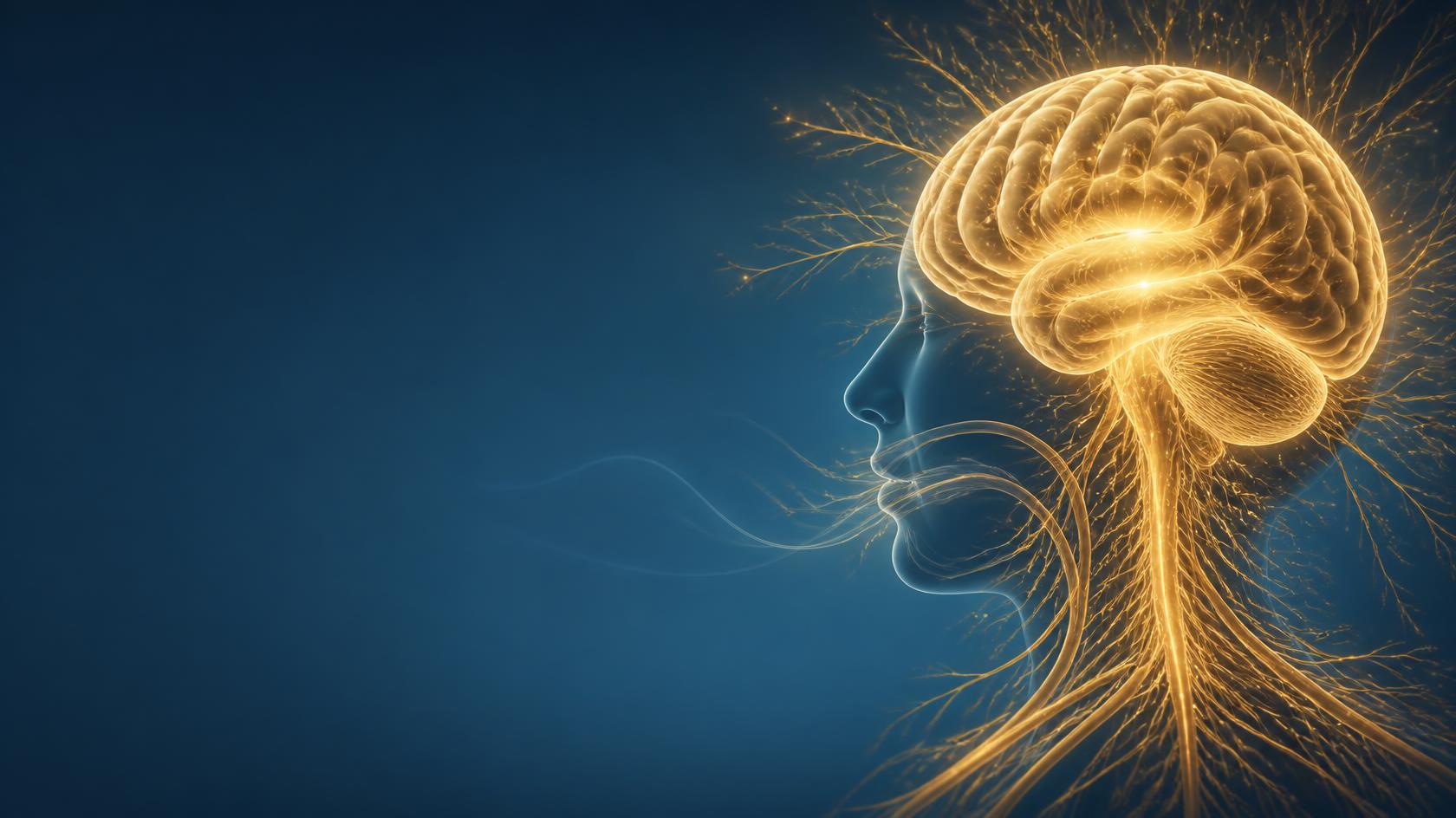
Precision and calm in the dental practice.
NESA supports dental medicine in bruxism and temporomandibular dysfunction through autonomic regulation.
Do you recognise yourself?
Jaw clenching and teeth grinding
Like a jaw shaped into a clenched fist. Constant stress “clenches the fist”: clenching, grinding and orofacial tension, day and night.
Self-assessment, not self-diagnosis — discuss with a professional.
Non-invasive modulation of the autonomic nervous system.
Bruxism
Reduction of muscle tension.
TMD
Support in temporomandibular dysfunction.
Calm
Lowering patient stress.
Download the NESA presentation.
Mechanism, indications, protocols and clinical data for implementing NESA.
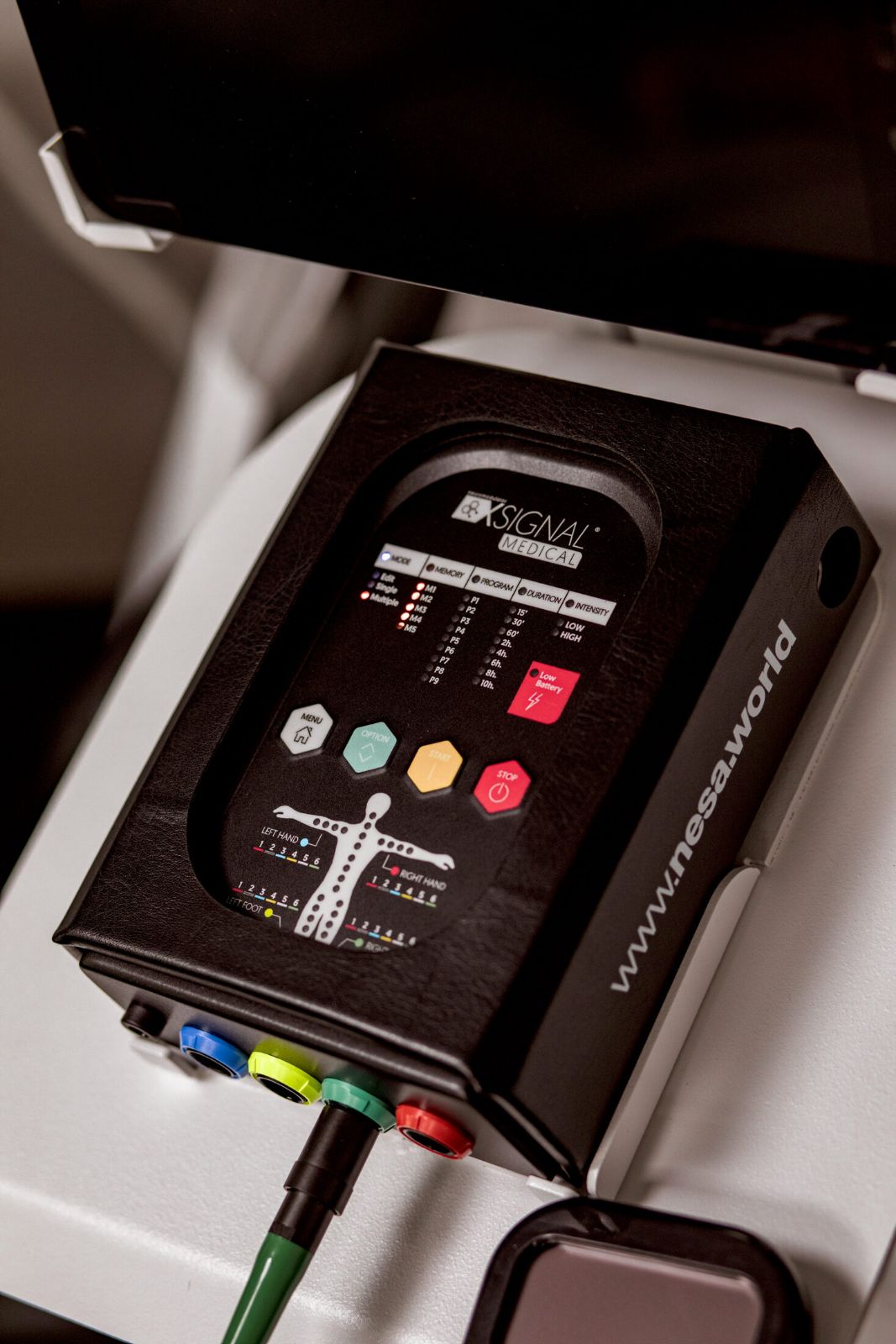
Microcurrents through the wrists and ankles — the whole autonomic axis at once.
Where anxiety and tension affect the outcome.
NESA (non-invasive ANS neuromodulation, XSIGNAL) complements dental and maxillofacial care without replacing it. The orofacial region is densely innervated by trigeminal afferents closely wired to autonomic and central circuits. Sustained sympathetic dominance lowers the pain threshold, intensifies muscular tension (bruxism) and delays recovery.
Clinical fields: acute intra-procedure anxiety, pre-operative anxiety, post-procedure recovery, orofacial pain, bruxism, trigeminal neuropathy (I/II), Burning-Mouth syndrome. Three-phase lead-electrode logic: central (sternum, C7) → metameric (C2/C3) → focal (complaint zone, V3 or Gasser ganglion). 60-min session, LOW; HIGH only for B8 with no response after 12 sessions.
For dentistry our source has no field-specific RCTs. The effect is mechanism-based — ANS modulation, anxiety regulation and HRV. As proof of principle (not field-specific):
prefrontal alpha waves (10 sessions); −30% anxiety/obsession/hostility (20 sessions) — Álvarez de los Heros, UAH 2019.
HRV (SDNN) and vagal tone (RMSSD).
Limits & safety: NESA promises no cure. Protocols are guidelines, not prescriptions; application requires individual medical/dental judgement. XSIGNAL is a medical device, not suitable for everyone. Absolute contraindications: pacemaker and pregnancy.
Bring NESA into your practice.
Real values from the handbook (INF-CD-022)
Central and mixed bruxism
Trigeminal neuropathy I
Source: NESA protocol handbook · INF-CD-022 (2025-V.1). Standard session 60 min, LOW mode by default.
At the core: programmes P1–P9
Every protocol in this field combines the reference programmes P1–P9 — general homeostasis, body levels, ANS/CNS and targeted nerves — according to the clinical goal.
See programmes P1–P9 →Protocols are guidelines, not prescriptions.
Parameters are guides; the therapist adapts them to the patient.
NESA is not suitable for every patient and promises no cure.
Absolute contraindications (pacemaker, pregnancy, active implants) follow the device IFU.