
Health built before a problem appears.
NESA maintains autonomic balance as a preventive measure — for resilience and better recovery.
Do you recognise yourself?
To tune it before it fails
Like tuning the engine before it fails. HRV reflects your autonomic reserve; low reserve means more background inflammation and higher risk — care today protects tomorrow.
Self-assessment, not self-diagnosis — discuss with a professional.
Non-invasive modulation of the autonomic nervous system.
Resilience
Support for stress resilience.
Monitoring
Objective tracking via HRV.
Balance
Maintaining autonomic balance.
Download the NESA presentation.
Mechanism, indications, protocols and clinical data for implementing NESA.
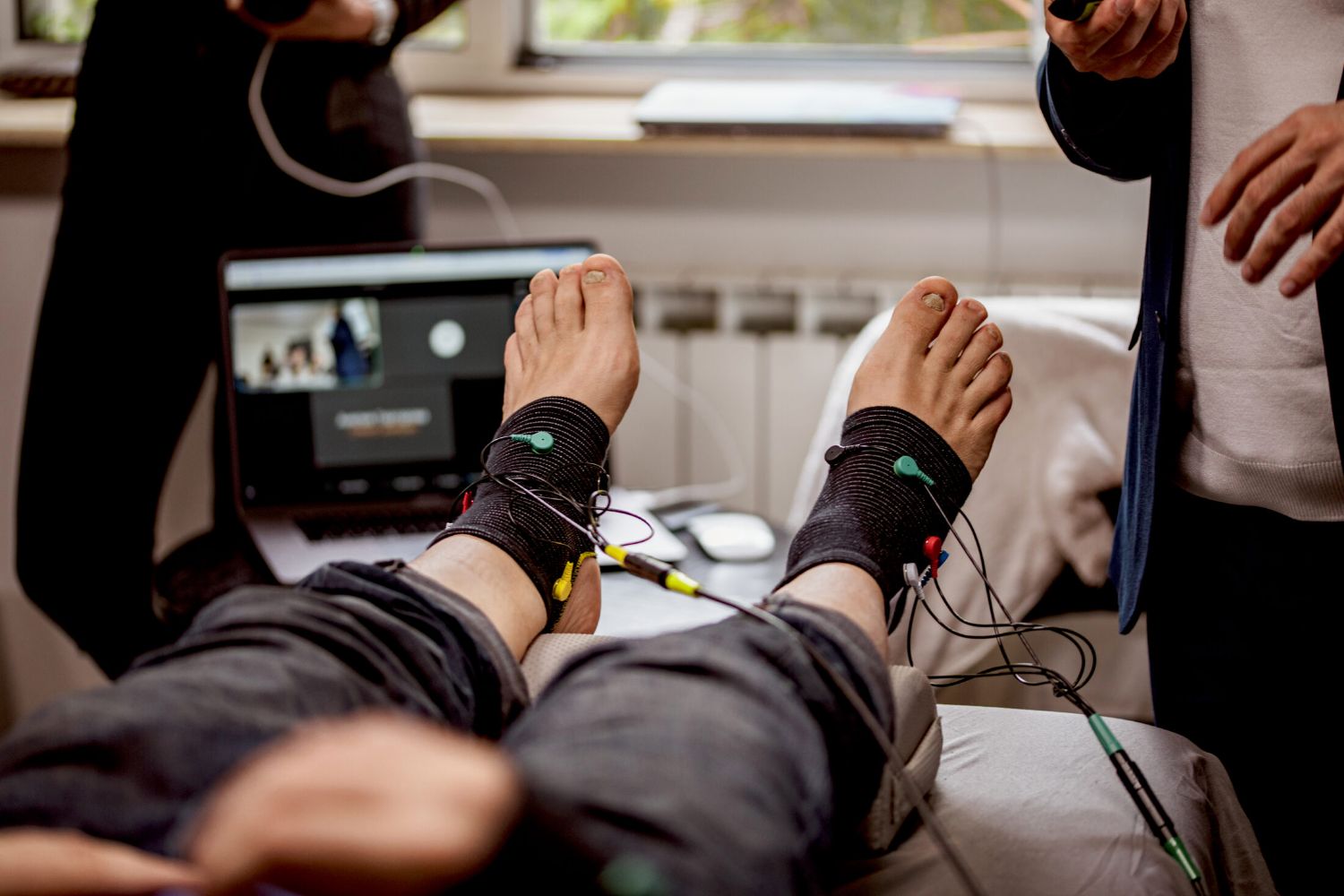
Microcurrents through the wrists and ankles — the whole autonomic axis at once.
Prevention means preserving adaptability.
The ANS regulates the balance between load and recovery — sleep, immune modulation and cardiovascular adaptation. Favourable vagal tone reflects robust regeneration. Chronic stress, high occupational load, surgery or age-related change shift the balance toward sympathetic dominance. NESA aims to support vagal tone and autonomic balance; HRV serves as an objective marker of the baseline and the course of the series (e.g. with WHOOP or actigraphy).
Clinical fields: prevention around surgery (C3), adjuvant anti-aging/longevity therapy (C4 — partly 45 min / HIGH), activation of immunological mechanisms (D2 — up to 30–40 sessions, cholinergic anti-inflammatory reflex) and quality of life for high-load professionals (C2). Three phases: central (sternum, C6–C7) → metameric → focal. 60-min session, LOW by default; HIGH only where explicitly stated.
For specifically preventive indications (perioperative prevention, longevity, high-load professionals) our base has no field-specific RCTs. Applications are mechanism-based — derived from the documented HRV and vagal principles. As proof of principle:
HRV (SDNN) and vagal tone (RMSSD).
an objective marker of autonomic balancing, trackable with standard wearables (WHOOP) and actigraphy.
Limits & safety: NESA promises no cure. Protocols are guidelines, not prescriptions; they complement — not replace — exercise, nutrition and medical prevention. XSIGNAL is a medical device, not for everyone. In a perioperative setting, use is coordinated with the treating team. Absolute contraindications: pacemaker and pregnancy.
Bring NESA into your practice.
Real values from the handbook (INF-CD-022)
Prevention in surgical procedures
Quality of life in older adults
Source: NESA protocol handbook · INF-CD-022 (2025-V.1). Standard session 60 min, LOW mode by default.
At the core: programmes P1–P9
Every protocol in this field combines the reference programmes P1–P9 — general homeostasis, body levels, ANS/CNS and targeted nerves — according to the clinical goal.
See programmes P1–P9 →Protocols are guidelines, not prescriptions.
Parameters are guides; the therapist adapts them to the patient.
NESA is not suitable for every patient and promises no cure.
Absolute contraindications (pacemaker, pregnancy, active implants) follow the device IFU.
Before you invest — the independent assessment.
We map clinical goals, workflows, budget and reimbursement — then recommend the solution that meets the department’s needs, not the easiest to sell.