
Stress regulation the body absorbs.
NESA balances the autonomic nervous system — regulating stress, anxiety and sleep, as a complement to psychological and psychiatric care.
Do you recognise yourself?
Anxiety and inner tension
Like a fire alarm that wails — with no fire. In anxiety the “gas” takes command and the “brake” (vagus) does not engage in time.
Self-assessment, not self-diagnosis — discuss with a professional.
Focus, order and calm — through autonomic balance.
Stress & anxiety
Reduction of sympathetic overactivity and of subjective tension.
Sleep
Better sleep quality — a key factor for mental health and recovery.
Sensory regulation
Support in autism spectrum disorders and sensory difficulties.
No pharmacological load
A non-invasive method that combines with psychotherapy and pharmacotherapy.
Microcurrents that recalibrate the nervous system.
NESA applies controlled low-intensity (0.1–1 mA) low-frequency (1–15 Hz) microcurrents through eight electrodes on the four limbs and one guide electrode. The signal reaches the autonomic nervous system and supports the balance between its sympathetic and parasympathetic branches.
In mental health this means lower sympathetic overactivity, deeper and more stable sleep, and better stress regulation — objectively measurable via EEG (increased alpha activity in the prefrontal cortex) and heart-rate variability.
Where NESA finds application in mental health.
In autism spectrum disorder, NESA improves behaviour, sleep and the sensory profile.
Álvarez de los Heros, University of Alcalá (UAH) 2019; study data in ASD. Individual results may vary. Information intended for healthcare professionals.
A clear frame for the treatment course.
A typical course in mental health. Parameters are adapted individually by the treating specialist and combined with ongoing therapy.
Built for mental-health professionals.
Mental-health clinics
Psychiatric wards and centres seeking a non-invasive complement to therapy.
Psychologists & psychotherapists
Private practices extending their scope with an objectively measurable method.
Children's centres · ASD / ADHD
Specialists in neurodevelopment, sensory integration and sleep disorders.
Full specialist presentation — psychology and psychiatry.
Indications, protocols, programmes and clinical data for implementing NESA in your practice.
Short answers for professionals.
Is the therapy safe?
Yes. NESA is a non-invasive, low-intensity method with no known systemic side effects. Sessions are conducted by a trained specialist.
Does it replace psychotherapy or medication?
No. NESA complements psychotherapy and pharmacotherapy by improving stress and sleep regulation — it does not replace them.
When are the first results felt?
Many patients report better sleep and calm after 4–6 sessions; a durable effect builds over the full course.
Are there contraindications?
Pacemakers and other active implants, pregnancy and epilepsy require prior medical assessment. When in doubt, consult the treating physician.
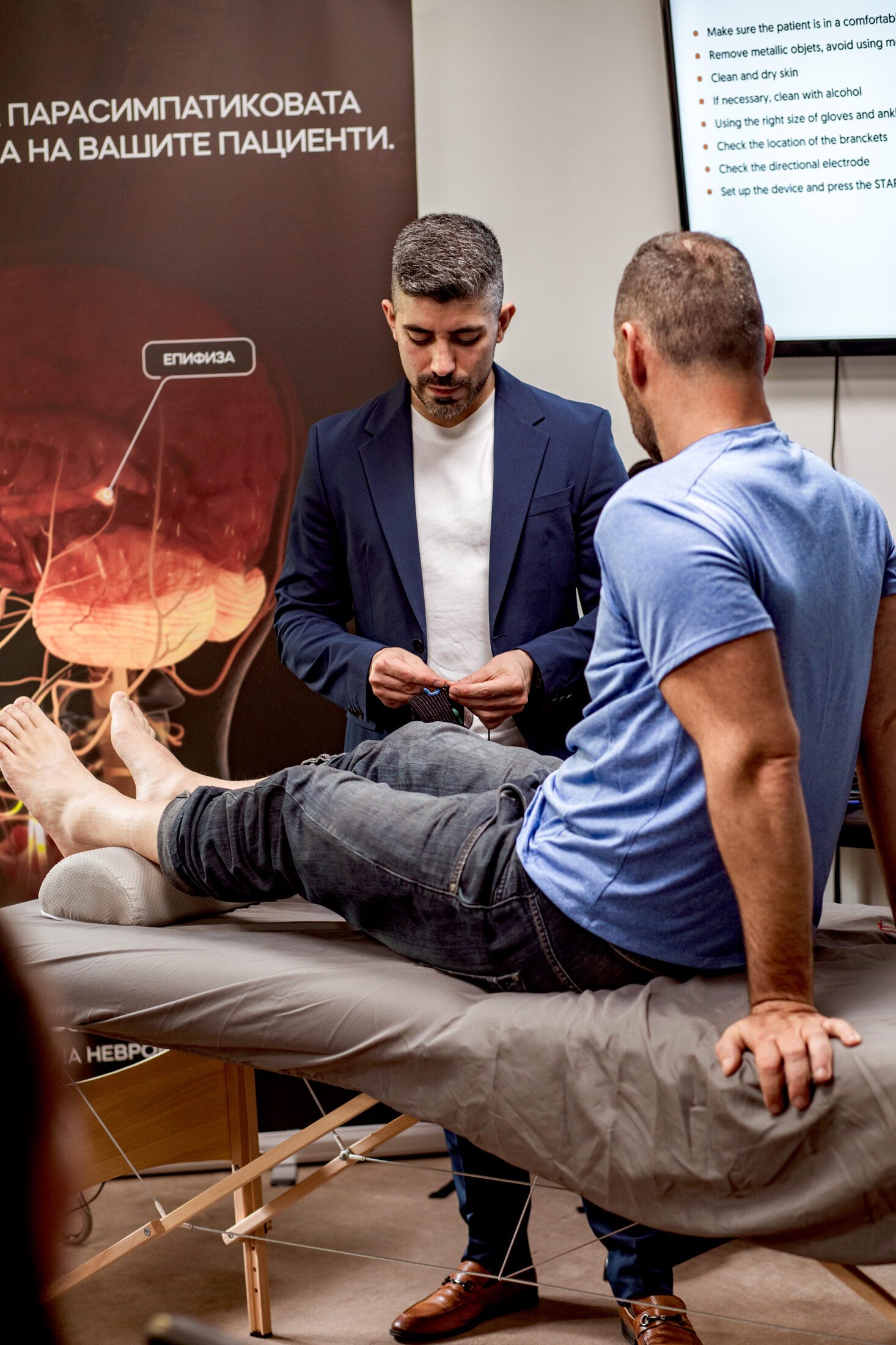
Microcurrents through the wrists and ankles — the whole autonomic axis at once.
Integrate NESA into mental-health care.
Real values from the handbook (INF-CD-022)
Anxiety and mood disorders
Sleep and anxiety
Source: NESA protocol handbook · INF-CD-022 (2025-V.1). Standard session 60 min, LOW mode by default.
At the core: programmes P1–P9
Every protocol in this field combines the reference programmes P1–P9 — general homeostasis, body levels, ANS/CNS and targeted nerves — according to the clinical goal.
See programmes P1–P9 →Protocols are guidelines, not prescriptions.
Parameters are guides; the therapist adapts them to the patient.
NESA is not suitable for every patient and promises no cure.
Absolute contraindications (pacemaker, pregnancy, active implants) follow the device IFU.
The clinical data as a shareable card.
The same numbers as above — in a ready-to-share format for colleagues, patients and social media.


Before you invest — the independent assessment.
We map clinical goals, workflows, budget and reimbursement — then recommend the solution that meets the department’s needs, not the easiest to sell.